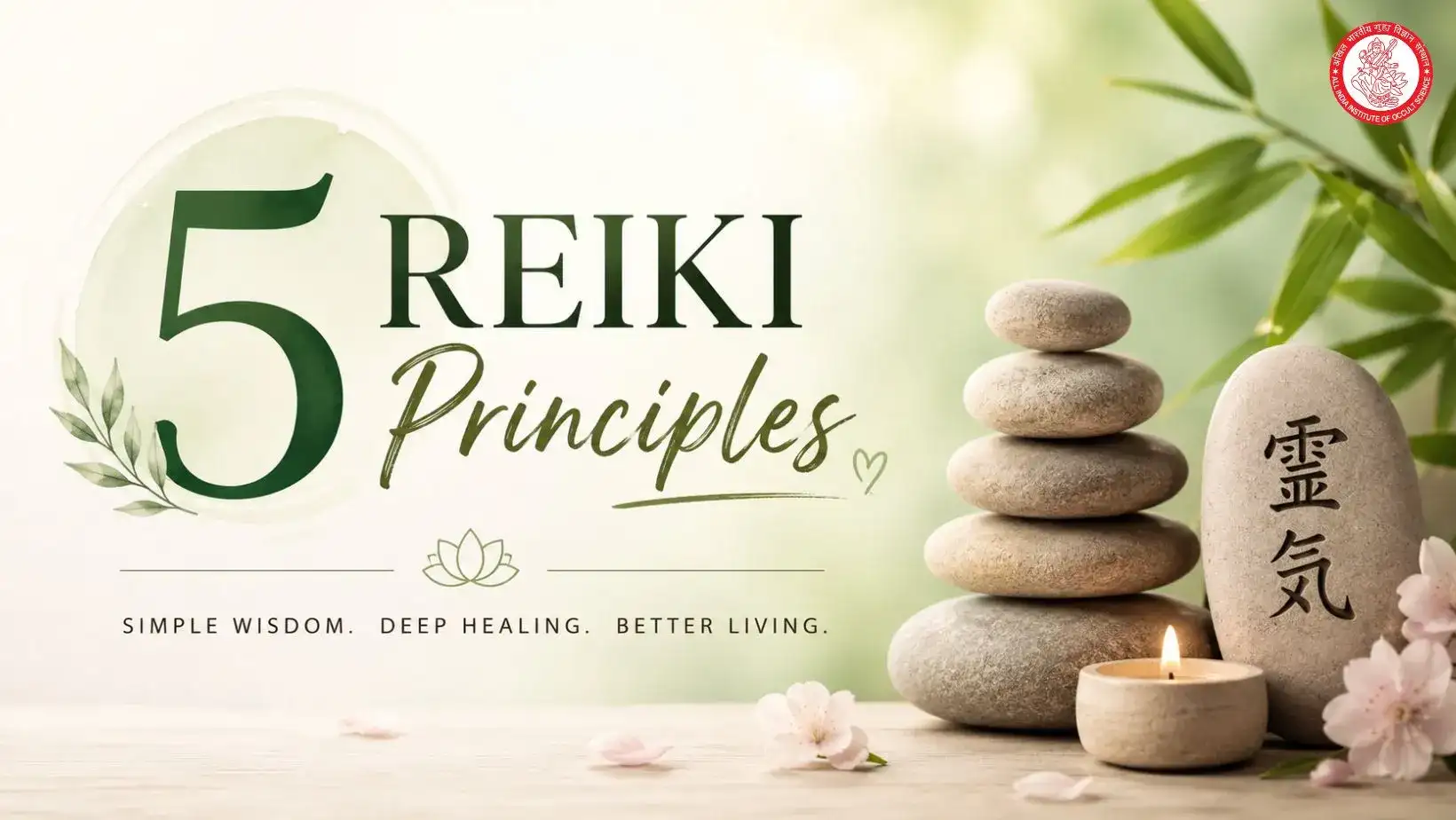
What if five simple daily intentions can help transform your emotional, mental and spiritual health? This is exactly what the 5 Principles of Reiki have been doing for practitioners worldwide for over a century, it has helped them reshape their inner world.
For those who are not familiar with Reiki - It is a Japanese healing practice, it is based on the idea that every human has an energy field or life force that affects how we feel and connect with the world around us. If the energy passage gets blocked by stress, overwhelming emotion, or the weight of day to day life,our mind and body feels it.
The 5 Principles of Reiki are the daily foundation that keeps that energy moving. So, let's explore their origin, understand the meaning they carry, and look at how you can practice them every single day.
What are the 5 principles of Reiki?
The 5 Principles of Reiki, also known as the Reiki Precepts, the Reiki Ideals, or in their original Japanese form, the Gokai are a set of five daily ethical intentions created by the founder of Reiki, Dr. Mikao Usui, and passed down to his students as the spiritual foundation of Reiki practice.
Each Reiki principle starts with the same four words- “just for today”.
This is the whole philosophy behind it - not forever, not always, not for the rest of your life. Just. For. Today.
The principle which are used most widely in english form are:-
-
Just for today, I will not be angry
-
Just for today, I will not worry
-
Just for today, I will be grateful
-
Just for today, I will do my work with honesty.
-
Just for today, I will be kind to every living being including myself.
The origin of 5 principles
Dr. Mikao Usui, the founder of Reiki, realized that Energy healing alone isn’t enough. He noticed that people would feel great after a Reiki session, but if they went back to a life full of stress, anger, and worry, the healing would fade away. To make the healing last, he knew his students needed a "mental compass" they could carry anywhere.
In 1922, after a deep 21-day meditation on Mount Kurama in Japan, he created the Gokai (The 5 Principles). He didn’t call them "rules" to follow; he called them "Ideals" something to aim for with kindness, not something to feel guilty about if you miss a day.
Eventually, in 1937, these principles traveled from Japan to the West, becoming the global heartbeat of Reiki healing that we know today.
The Original Japanese Gokai
|
S. No. |
Japanese |
Romaji |
English Meaning |
|
1 |
今日だけは怒るな |
Kyō dake wa, ikaru-na |
Just for today, do not anger |
|
2 |
今日だけは心配すな |
Kyō dake wa, shinpai suna |
Just for today, do not worry |
|
3 |
今日だけは感謝して |
Kyō dake wa, kansha shite |
Just for today, be grateful |
|
4 |
今日だけは業を励め |
Kyō dake wa, gyō wo hageme |
Just for today, work with diligence and honesty |
|
5 |
今日だけは人に親切に |
Kyō dake wa, hito ni shinsetsu ni |
Just for today, be kind to all living beings |
Here are the original japanese form, written exactly as written by Dr. Dr. Mikao Usui.
The Reiki Principles: Deep Meaning and Indian connect.
Each of the 5 Reiki Principles carries a deeper meaning - that connects directly to your energy body, and surprisingly, to Indian philosophy that most of us have grown up hearing about.
Let’s understand each one more deeply.
Reiki Principle 1: Just for Today, Don’t get angry
Anger is not just an emotion. In energy healing, it directly disturbs the Solar Plexus Chakra (Manipura) , the centre of your personal power, confidence, and identity. When anger stays unprocessed in this chakra, the body starts showing signs like digestive issues, high blood pressure, constant tension. It quietly drains you from the inside.
In Indian philosophy, this is known as - Ahinsa
Patanjali's Yoga Sutras place Ahinsa - non-violence as the very first quality a person must develop. And Ahimsa starts within you, not with others. Anger is an act of violence against your own energy before it ever reaches anyone else. The Bhagavad Gita (Chapter 16, Verse 2) also lists krodha-tyaga which means giving up anger is one of the highest qualities a person can achieve.
Dr. Usui said it in Japan in 1922. Patanjali said it in India centuries before that. The teaching is the same. Only the language is different.
Reiki Principle 2: Just for Today, Do Not Worry
Worry comes when you try to control a future that does not exist. And, it slowly drains the Sacral Chakra (Svadhisthana) . It is the energy centre that handles emotional flow, trust, and our ability to let life move naturally. With time, constant worry blocks this chakra and creates fear, emotional rigidity, and an inability to simply feel joy.
In Indian philosophy, this is known as - Aparigraha
Aparigraha means non-attachment; it is one of the five Yamas in Patanjali's Yoga Sutras. Worry is nothing other than tying you to a “what if” scenario to outcomes, to control, to what might or might not happen. And Lord Krishna addresses this directly in one of the most well-known verses of the Bhagavad Gita (Chapter 2, Verse 47):
"Karmanye vadhikaraste, Ma phaleshu kadachana"
Do your work. Do not worry about the results. You only have control over what you do right now, not what happens next. Reiki's second principle is this exact teaching, written in just different words.
Reiki Principle 3: Just for Today, Be Grateful
Gratitude is not just a feeling that varies from time to time. It is a choice you make. In energy healing, it is the fastest way to open the Heart Chakra (Anahata) and shift how your entire body feels. When you are genuinely grateful, you stop resisting your life. And in that stillness, healing moves freely.
Dr. Usui placed gratitude right in the centre of all five principles in the third place out of five, because it is the literal and symbolic heart of this practice.
In Indian philosophy, this is known - Santosha
Santosha means contentment. It is the second Niyama in Patanjali's Yoga Sutras. It is the practice of finding fulfilment in what you already have, not because everything is perfect, but because you have chosen to accept the life which you have right now. Santosha is not giving up. It is simply saying “ right now, this is enough.”
Gratitude and Santosha are the same medicine in different bottles.
Reiki Principle 4: Just for Today, Work Honestly
Most people hear this and think it means "work harder at your job." It means something much deeper than that.
The Japanese word gyō that Dr. Usui used is closer to sacred action. It means every task you do, done with complete presence and full honesty. Do not cut corners when no one is watching. Do not work just to get by, it means to be present, to show up to whatever is in front of you.
This principle is connected to the Throat Chakra (Vishuddha), the centre of truth and honest expression. When we are dishonest in our actions, even in small everyday task, this chakra quietly tightens. We lose clarity and slowly stop trusting ourselves.
In Indian philosophy, this is known as - Satya and Karma Yoga
Satya means truthfulness; it is the second Yama in the Yoga Sutras. And this principle also is in Karma Yoga from the Bhagavad Gita - the path of devoted and ego-free action. When you do your work as an offering, without waiting for recognition or reward, you are practicing Karma Yoga. You are also living Reiki Principle Four just in different traditions but Same truth.
Reiki Principle 5: Just for Today, Be Kind to Every Living Being
The fifth principle is the widest of all five. It does not say be kind to people who deserve it. It does not say be kind when it is easy or convenient. It says every living being - the person who frustrated you this morning, the stranger you passed on the street, the animal in distress, and most importantly, yourself.
That last part is where most people quietly struggle. We are often the harshest toward ourselves - for not being enough, for old mistakes, for not healing as fast as we think we should. Reiki's fifth principle says, not today. Today, kindness starts with you too.
This principle opens the Crown Chakra (Sahasrara) -the centre of universal consciousness, the understanding that all life is deeply connected.
In Indian philosophy, this is known as - Karuna and Vasudhaiva Kutumbakam
Karuna means compassion; it is one of the four divine spaces in both Hindu and Buddhist philosophy. It is the genuine wish that all beings be free from suffering including themselves. And then there is this ancient declaration that India has carried for thousands of years:
Vasudhaiva Kutumbakam - The world is one family.
When you live with kindness toward every living being, you are not just practicing Reiki. You are living the most beautiful Indian truth.
The chakra and principle Map
|
Reiki Principle |
Chakra |
Sanskrit Name |
What It Heals |
|
Do not anger |
Solar Plexus Chakra |
Manipura |
Personal power, ego, inner fire |
|
Do not worry |
Sacral Chakra |
Svadhisthana |
Emotional flow, trust, surrender |
|
Be grateful |
Heart Chakra |
Anahata |
Love, openness, abundance |
|
Work honestly |
Throat Chakra |
Vishuddha |
Truth, integrity, authentic expression |
|
Be kind |
Crown Chakra |
Sahasrara |
Unity consciousness, divine connection |
How to Practice the 5 Reiki Principles Daily
You do not need a Reiki attunement or any special equipment for this. Just five minutes from your day and genuine intention to practice is enough.
Step 1 - Find a spot away from all the noise, Sit there comfortably with your spine straight. It could be your bed, a chair, your balcony anywhere works, as long as you will not be disturbed.
Step 2 - Bring both palms together in front of your heart, fingers pointing upward. This is called Gassho, it is called the prayer position. It is how you signal to your mind that this is a moment of intention.
Step 3 - Take three slow, deep breaths. Inhale through the nose, exhale through the mouth. Relax your shoulders and body.
Step 4 - repeat each principle out loud, slowly, one by one.
-
"Just for today, I will not be angry."
-
"Just for today, I will not worry."
-
"Just for today, I will be grateful."
-
"Just for today, I will do my work honestly."
-
"Just for today, I will be kind to every living being."
Do not rush, say every line like you mean it.
Step 5 - Sit quietly for one minute. Without any distractions, no phone, no worry just let it settle within yourself.
And before sleeping take two minutes to gently look back at your day. Which principles did you manage to follow? Where did you struggle? No judgment, just honest reflection. That small habit, done consistently, is more powerful than it sounds.
But once a day done with full presence is always better than twice done in a hurry.
The 5 Principles of Reiki are not for special moments. They are for the heavy mornings, the long evenings, the days when showing up is all you can do. Just for today. That is all they ask. And that is enough.
Want to learn Reiki or experience a healing session under expert guidance? Explore Reiki courses, workshops, and healing sessions.
FAQs:
Q1. What does "Just for Today" actually mean?
Ans. "Just for today" removes the guilt of yesterday and the pressure of tomorrow. It gives you a clean start every single morning, no matter what happened the day before.
Q2. Can the Reiki Principles be practised without training?
Ans. Yes. These principles were made for everyone, not just for Reiki practitioners. You do not need an attunement or any prior knowledge. practicing them every morning with genuine intention is a complete practice on its own.
Q3. How many times should the Reiki Principles be practised in a day?
Ans. You should practice it twice on a daily basis, morning to set your intention, evening to reflect.